I've been going deep on AI-bubble economics lately, and I want to write down where I actually land, because most takes pick one of two lazy positions. Either AI is fake and the whole thing collapses next quarter, or AI is the new electricity and no price is too high.
I run three companies with AI wired into daily operations, and at this point 90% of the code we ship is AI-written, at real scale, with hiring, content, and reporting automated on top. So I have skin on the user side of this trade.
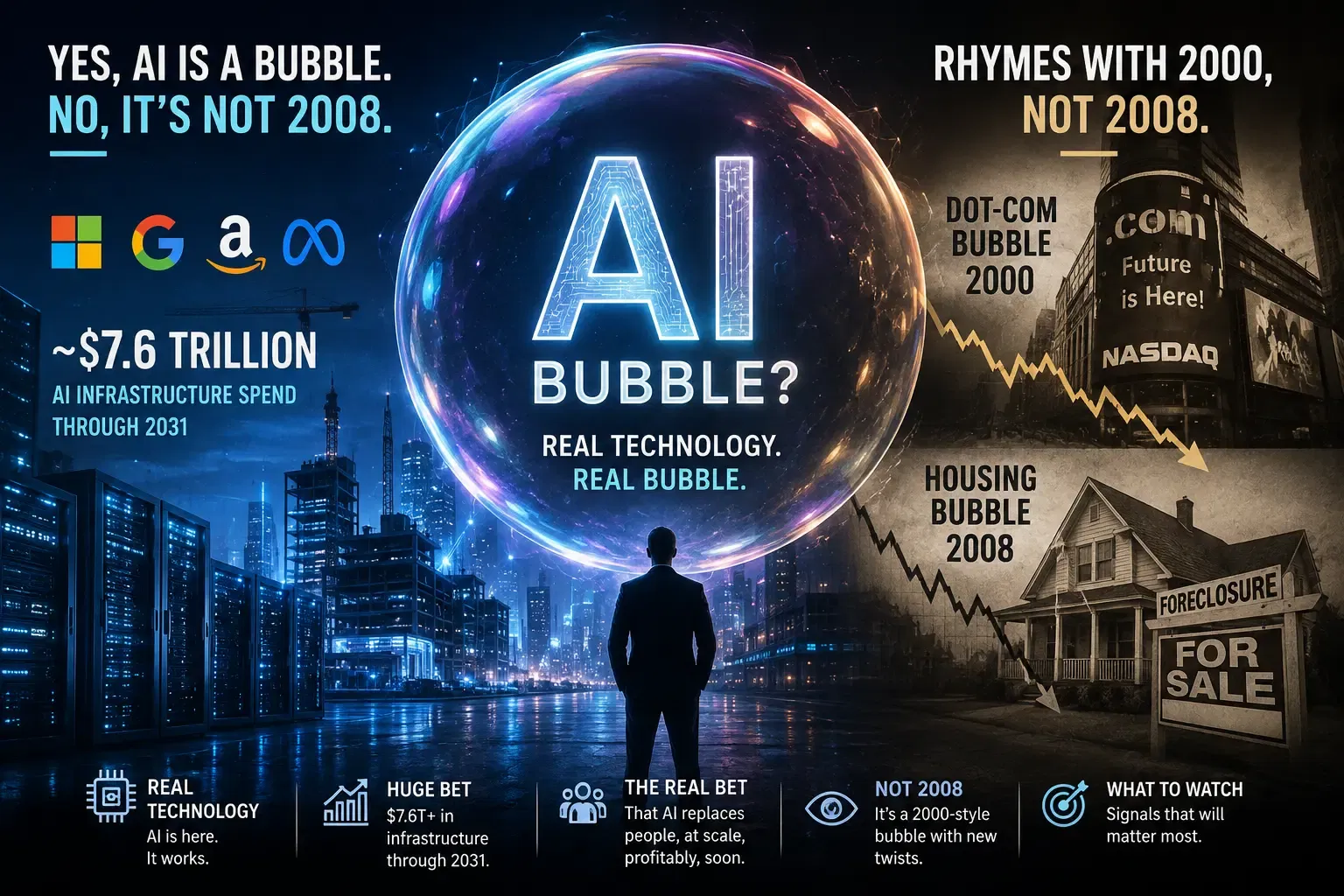
And once you pull the numbers from filings and research desks instead of hype threads, they tell a more specific story: this is a real technology inside a real financing bubble, and the crash it rhymes with is 2000, not 2008, with a few new twists that make even that comparison too kind.
This is a long one. I'll cover the size of the bet, what AI adoption actually looks like from the buyer's seat, how the buildout is being financed, how it compares to the railroad, dot-com, and housing bubbles, why your next phone and your electricity bill are already paying for it, and what I'd actually watch for.
The size of the bet
Start with the raw numbers, because they've gotten so big they stop registering.
The four big hyperscalers (Microsoft, Alphabet, Amazon, Meta) spent about $226 billion on capex in 2024. In 2025 that hit roughly $410 billion. Their 2026 guidance adds up to somewhere around $700 billion, a 77% jump in one year.
Goldman Sachs projects $5.3 trillion of cumulative hyperscaler capex through 2030, and about $7.6 trillion of total AI infrastructure spend (compute, data centers, power) through 2031.
To put that in perspective: the economist Jason Furman pointed out that investment in information-processing equipment and software, about 4% of US GDP, accounted for 92% of American GDP growth in the first half of 2025. Strip out the AI buildout and the world's largest economy grew 0.1%. One sector is carrying the entire expansion on its back.
Now the other side of the ledger. Enterprise generative-AI spending tripled last year to about $37 billion (Menlo Ventures). OpenAI did $13 billion of revenue in 2025. Anthropic crossed a $30 billion annualized run rate this spring. That's real money growing at rates software has never seen.
It is also nowhere near enough: the gap between annual AI infrastructure spend and annual AI ecosystem revenue is estimated around $600 billion and widening. Bain projects an $800 billion revenue shortfall by 2030.
Here's the uncomfortable arithmetic that follows. A $7.6 trillion buildout needs hundreds of billions of dollars of new profit every year to justify itself. No software budget on Earth is that big. The only corporate line item large enough to close the gap is payroll.
Whatever the press releases say, the capex is priced against white-collar labour budgets. The bet is that AI replaces people, at scale, profitably, soon.
What replacement actually looks like from the buyer's seat
I'm the customer this trade is priced on, so let me report from the ground.
The independent numbers first. MIT's Project NANDA studied hundreds of enterprise deployments and found 95% of generative-AI pilots produced no measurable P&L impact. McKinsey's survey work says 88% of companies now use AI somewhere, while only 39% can point to any effect on earnings. Gartner expects over 40% of agentic AI projects to be cancelled by 2027.
Whatever is being bought, it isn't showing up in operating income yet.
My own experience explains why, and it's not that the technology doesn't work. It works. Start with the strongest case there is: coding. Every line of code I ship across my companies is AI-written now, all of it, at scale. I set direction, review, and verify; the models type. One person now ships what used to take a small team, and I'd never go back.
But look closely at what even the best case did: it multiplied a person. It didn't delete a payroll. The judgment about what to build, whether it actually works, and whether it should ship stayed exactly where it was.
The whole team works the same way: AI assists on everything, and assistance is the operative word. Everyone is faster. Nobody is dependent. If every model API went dark tomorrow, we'd be slower and annoyed, not dead.
That's what successful AI adoption actually looks like from inside a company, and notice that it's a productivity story, not a headcount story. The capex needs a headcount story.
The same pattern holds in the smaller automations. I have a workflow that scores interview transcripts against my hiring rubrics and posts a verdict to Slack. Another writes SEO blog drafts end to end. I'd genuinely miss both, but neither replaced a person.
The interview scorer replaced the first twenty minutes of my own screening, not a recruiter. The blog pipeline still ends with a human reviewing a draft, because the one time you skip that review is the time it hallucinates a statistic onto your company's site.
Getting even these narrow things reliable took real engineering: prompt iteration, validation steps, fallbacks for when the model returns garbage. AI eats tasks, one at a time, each purchase paid for in setup and babysitting.
Nobody at my companies has been replaced by it. The real effect is quieter: work that would have justified a new hire gets absorbed instead, and absorbed hires never show up in a layoff statistic. That's genuine value. It is also roughly two orders of magnitude less value than the financing requires, on a much slower clock.
Two more things suppress the replacement rate. First, incentives: a lot of corporate AI adoption was mandated top-down and measured by usage instead of outcomes. Measure usage and you get usage; teams point agents at busywork and the dashboard goes up while nothing ships.
Second, liability: a Canadian tribunal ordered Air Canada to honour a bereavement policy its chatbot invented, establishing that whatever your AI tells a customer, you told them. That ruling alone guarantees a human stays in every loop that touches money or promises.
Task-level automation with human gates is the steady state, and it does not fire ten million people a year.
How the buildout is being paid for
This is the part that convinced me "bubble" is the right word, because the financing structure has changed shape three times in three years, and each shape is riskier than the last.
Stage one was cash. The four sponsors are the most profitable companies in the history of money, generating around $600 billion a year in combined operating cash flow. For a while the buildout just ate that. It still eats most of it.
Stage two is bonds. The five big issuers (add Oracle) averaged about $28 billion a year of investment-grade issuance from 2020 to 2024. In 2025 they issued $121 billion. Through late July 2026, Amazon, Alphabet, Meta, and Oracle alone have issued roughly $194 billion, nearly double all of last year with five months to go.
Meta's October 2025 deal was $30 billion, the largest non-acquisition investment-grade bond sale ever, with a $125 billion order book. Alphabet has sold 100-year paper in euros. Those four companies' weight in the US investment-grade index nearly doubled in a year, from 2.2% to 4.1%. Goldman expects the debt-funded share of AI capex to pass a third by 2027.
Stage three is the part that should raise your eyebrows: the financing is moving off the balance sheets entirely.
The flagship is Meta's Hyperion data center in rural Louisiana, funded through a special purpose vehicle called Beignet Investor LLC: $27 billion of debt arranged by Morgan Stanley, Blue Owl Capital owning 80% to Meta's 20%, A+ rated paper maturing in 2049, the largest private-credit deal ever done.
Because Meta owns only 20%, the debt legally isn't Meta's. Meta then quietly guarantees the building's residual value in its own filings, which means the risk didn't leave, only the disclosure did.
Moody's counts about $662 billion of future data-center lease commitments across five hyperscalers, roughly a trillion dollars of total obligations, much of it invisible on the face of the balance sheets, and has warned openly about what this does to credit quality. Over $120 billion of spending moved off-book through structures like this in about eighteen months.
Then there's the circular money. Nvidia has committed up to $100 billion into OpenAI in tranches tied to deploying Nvidia hardware. OpenAI signed a five-year, $300 billion compute contract with Oracle, which itself bought about $40 billion of Nvidia GPUs to serve it, and a 6-gigawatt chip deal with AMD that came with warrants on roughly 10% of AMD's stock.
CoreWeave, the biggest pure-play GPU cloud, grew its debt from $8 billion to $21 billion in a year, much of it secured against the GPUs themselves, with most of its revenue coming from one or two customers.
The vendor is financing the customer, who signs commitments with the vendor's other customers, who buy from the vendor. Revenue is real on every invoice and circular in aggregate.
And sitting at the center of the web is one company: OpenAI has announced infrastructure commitments totaling around $1.4 trillion, and plans roughly $750 billion of compute spending through 2030, against $13 billion of 2025 revenue and about a $21 billion operating loss.
When one loss-making company's purchase commitments underwrite the revenue assumptions of Nvidia, Oracle, AMD, Microsoft, and the entire neocloud sector simultaneously, that is not diversification. That's a single point of failure wearing five costumes.
Who ends up holding all this paper? Mostly not banks. The Chicago Fed puts direct bank exposure to AI-adjacent industries at about 0.8% of assets.
The buyers are bond funds, pensions, and above all insurers: US life insurers now hold about $1.8 trillion of private credit, a record 46% of their debt holdings, and they're the natural buy-and-hold lenders on 20-year data-center paper. Remember that for later.
Three ghosts: 1880s, 2000, 2008
Every bubble debate eventually reaches for history, so let's do it properly, because the three usual comparisons give three different answers.
The railroads are the pattern-setter. At the 1880s peak, railroad investment ran around 6% of US GDP. The technology transformed the economy exactly as promised, and the financing still blew up repeatedly, wiping out investors in 1873 and 1893 while the rails kept carrying freight for a century.
Lesson one, and it's the most important one: "transformative technology" and "ruinous investment" are fully compatible. The bulls citing AI's usefulness and the bears citing its financing can both be right.
The 2000 telecom and dot-com bust is the closest structural rhyme to today's asset side. Telecom capex peaked around 1.2% of GDP. The industry issued over $500 billion of bonds in five years; the FCC chairman told the Senate the sector owed about a trillion dollars, "much of which will never be repaid."
Equipment vendors financed their own customers (Lucent committed $8.1 billion, Nortel $3.1 billion, Cisco $2.4 billion), booking revenue on loans to buyers who then went bankrupt, 47 of them among the upstart carriers alone. Capacity ran a decade ahead of demand: by 2002, less than 5% of the fiber in the ground was lit.
Cisco traded at 201 times earnings as the most valuable company on Earth. When it broke, the Nasdaq fell 78%, over $5 trillion of market value evaporated, and the index needed fifteen years to reclaim its peak.
And yet the real-economy damage was mild: an eight-month recession, unemployment peaking at 6.3%, no banking crisis. Losses fell on dispersed shareholders and junk bondholders, not on the credit system. The overbuilt fiber, bought for cents on the dollar out of bankruptcy (Global Crossing's buyers paid $250 million for a controlling stake in a network that cost tens of billions), spent two decades carrying broadband, streaming, and the cloud.
2008 was a different animal entirely, and the difference was never the asset. Housing investment peaked around 6.5% of GDP. Mortgage debt doubled from $5 trillion to $10.3 trillion in seven years, pushing household debt to 129% of disposable income.
The plumbing multiplied it: $1.2 trillion of asset-backed commercial paper, $400 billion parked in off-balance-sheet SIVs, $62 trillion of credit default swaps, broker-dealers running 30-to-1 leverage on overnight funding. By 2007 the shadow banking system's liabilities exceeded the traditional banking system's.
When house prices fell 27%, the leverage sat on household balance sheets and inside the credit-creating core, so the loss transmitted everywhere at once: a 57% equity drawdown, GDP down 4.3%, unemployment at 10%, eleven trillion dollars of household wealth gone, and two-thirds of $4 trillion in global writedowns landing on banks.
So where does AI sit? Here's my scorecard.
The asset economics are 2000: capacity built years ahead of monetization, vendor financing loops, a valuation-anointed hardware champion, capex as a share of GDP already past telecom's peak (roughly 1.3% now, with projections near 3% by 2027) and heading toward half of what housing hit.
The financing costume is 2008: special purpose vehicles, obligations in the footnotes, a small club of repeat lenders, risk formally transferred while economically retained. The economist who coined "shadow banking" at Jackson Hole in 2007 would recognize Beignet Investor LLC on sight.
But the leverage placement is 2000, not 2008, and this is the decisive point. There is no household borrowing leg: nobody is taking a second mortgage to buy GPUs. The banks are bystanders by 2008 standards, holding capital ratios roughly double their pre-crisis levels, with direct AI exposure under 1% of assets.
The debt sits with profitable sponsors, bond funds, insurers, and private credit. When this reprices, losses fall on investors, not on the machinery that creates credit for the rest of the economy. That's the difference between a crash and a crisis.
One honest caveat: about a quarter of bank lending to non-banks now flows into private credit funds, up from 1% a decade ago, so the firewall between the banks and the shadow is thinner than the headline exposure suggests.
The three ways this is genuinely worse than 2000
If I stopped there, the conclusion would be comforting: a Nasdaq-style drawdown, a capex recession, a mild real-economy dent, and cheap infrastructure for the survivors. But three things are structurally worse this time, and none of them gets enough attention.
First, the assets melt. Telecom's saving grace was that fiber is patient: it sat dark for a decade and then carried YouTube. Around 60% of an AI data center's cost is IT equipment, and GPUs alone are 40-50%.
Hyperscalers depreciate that hardware over five to six years; critics like Michael Burry argue the real economic life is two to three, and that the industry is understating depreciation by around $176 billion between 2026 and 2028, flattering reported profits by 20% or more. You can debate his numbers, but the direction is undeniable: H100 rental prices have already fallen from about $8 an hour in 2023 to roughly $2.50 today, on hardware barely three years old.
Dark fiber could wait for demand. Dark GPUs become scrap while they wait. If demand arrives even three years late, the overbuilt capacity won't be a bargain for the next generation, it will be landfill, and the "we'll grow into it" defense dies on the depreciation schedule.
Second, the losses are pre-distributed to everyone. In March 2000 the ten largest stocks were 27% of the S&P 500. Today the top ten are around 40%, Nvidia alone is about 8%, and passive index funds hold roughly a third of the US equity market, taking in $1.5 trillion of new money last year.
In 2000 you had to actively decide to buy Pets.com. In 2026 every salaried person with a retirement account owns the AI trade automatically, at the largest index weight ever recorded, and the insurers guaranteeing annuities own the debt side of the same trade at a record 46% of their portfolios.
2008 needed a banking system to transmit losses to ordinary households. This cycle pre-installed the transmission: no bank failure required, the index does it directly.
Third, everyone is already paying for this bubble, whether they bought in or not. This is the part that separates it from every previous tech bubble, and it's happening before anything has popped.
The memory makers (Samsung, SK Hynix, Micron) have shifted their fab capacity toward HBM, the high-bandwidth memory that AI accelerators eat, because that's where the margin went. Ordinary DRAM and NAND, the stuff in everything else, got starved.
TrendForce's contract-price data tells the story: conventional DRAM prices rose 90-95% in Q1 2026 alone, with PC memory up 105-110% in a single quarter. DDR5 spot prices tripled in under three months in late 2025. A 32GB RAM kit that cost under $90 in early 2025 now runs around $500. NAND followed: contract prices up 70-75% in Q2 2026, consumer SSDs roughly doubled.
And memory is in everything, so everything is repricing. Raspberry Pi raised prices three times in five months and said plainly it was "competition for memory fab capacity from the AI infrastructure roll-out." Dell, Lenovo, and Acer pushed PC prices up 10-25%. Apple repriced the MacBook line upward this June, and TrendForce estimates the next iPhone Pro's build cost rises 38% year on year, with memory going from about 10% of the bill of materials to 34%.
The Xbox Series X went from $500 to $800. Hikvision and Dahua, who make half the world's CCTV cameras, announced increases with storage-heavy recorders hit hardest. Automotive memory is up ~70% year on year, so it's in your next car too.
Even your electricity: in America's largest power market, the capacity auction cleared at nine times the prior year's price, with independent analysis attributing about two-thirds of the increase to data centers. And the memory makers say the shortage runs into 2027 and possibly 2028, because a new fab costs $15-20 billion and takes years.
Notice the inversion. The telecom bubble subsidized bystanders: the glut collapsed bandwidth prices by up to 90%, a gift to everyone who never owned a telecom share. This bubble taxes bystanders: it outbids ordinary products for memory, storage, and power while it inflates.
You can own no AI stock, use no chatbot, and still pay for this buildout every time you buy a phone, a laptop, a security camera, or a unit of electricity. The last shock that repriced everyday goods this indiscriminately was the covid supply-chain squeeze, and that's the right mental model: you didn't have to hold airline stocks to pay for that one either.
That's the honest picture. Not a 2008 systemic freeze. A 2000-style repricing whose equity losses land on household balance sheets far more efficiently than 2000 ever could, with an asset base that depreciates too fast to redeem the overbuild afterwards, financed by a buildout that's already taxing everyone's electronics and electricity on the way up.
What I'd watch, and what I'm doing
If this framework is right, the tells to watch aren't model benchmarks. They're accounting artifacts.
- Watch for hyperscalers quietly extending server depreciation schedules while chip generations shorten.
- Watch the neocloud refinancings: CoreWeave and its peers are this cycle's competitive local carriers, leveraged, customer-concentrated, and collateralized by melting hardware.
- Watch OpenAI's funding cadence against its $750 billion of planned compute.
- Watch insurance regulators' interest in private-placement data-center paper.
And history says every bubble of this size eventually produces its WorldCom; mine says this one's will be a depreciation or SPV-disclosure scandal rather than fake revenue.
Meanwhile, none of this changes what I do Monday morning, and that's the point most bubble commentary misses. The railroads crashed and the trains ran. The fiber glut bankrupted its builders and then carried the internet.
If AI equity and credit reprice, the models don't get worse: the open weights are already out there and nobody can un-release them, and the skills people are building wiring this stuff into real workflows become more valuable when the subsidy ends and every deployment has to justify itself.
So: keep building on the technology, and hold it to outcome metrics, never usage metrics. Keep a human gate on anything that touches money or makes promises to customers. Treat every AI line item as something that has to pay for itself this month, because the era of below-cost tokens is exactly what a bubble subsidizes and exactly what ends.
And when the desperate late-cycle IPOs arrive, priced on the assumption that the labour-replacement miracle is one more funding round away, let someone else be exit liquidity.
It's a bubble. It's also real.
Both were true of every general-purpose technology we've ever financed badly, and we've never once financed one well.
Done.